Call for Papers
The Nigerian Journal of Renewable Energy Research (NJRER) is dedicated to advancing and sharing knowledge on the diverse topics and technologies related to renewable energy systems and components. Its objective is to assist professionals such as researchers, engineers, economists, manufacturers, NGOs, associations, and societies to stay updated with the latest advancements in their respective areas, ensuring the integration of sustainable energy alternatives into existing practices.
We welcome the submission of original Research Articles, Reviews, and Short Communications in all fields related to Renewable Energy. Nigerian Journal of Renewable Energy Research (NJRER) is an Open-Access, Peer-Reviewed journal that publishes high-quality research articles, which undergo a rigorous review process by experts in the respective fields.
Submit Manuscript
Submit Manuscript via Email: editor_njrer@tetfundkadpolycoex.org.ng
Frequency: Biannual
Type of Articles: Research Paper, Survey Paper, Informative Article, Case Studies, Review Papers and Comparative Studies.
Article Publication: Maximum 3 Days, Accepted Language: English Only
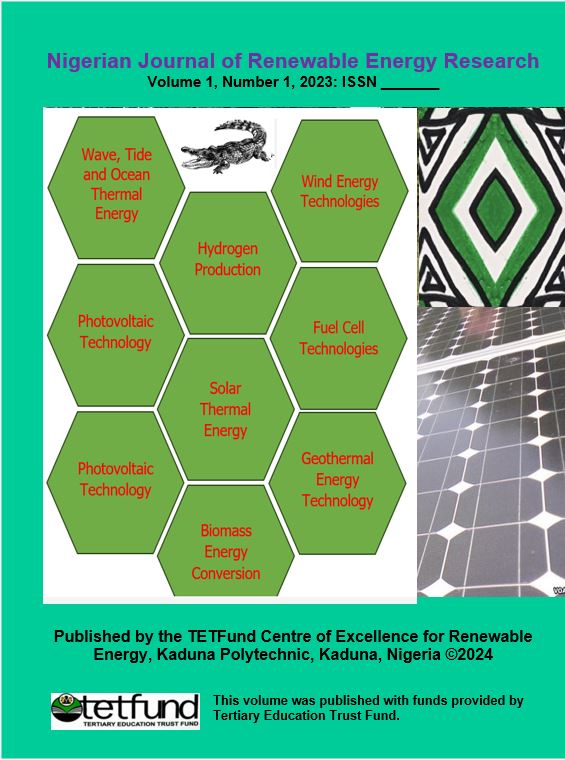
Disciplines Covered: Photovoltaic Technology Transformation, Applications of Solar Thermal Energy, Advancements in Geothermal Technology, Wave, Tide and Ocean Thermal Energy Innovations, Advancements in Hydro Power, Biomass Energy Conversion, Wind Energy Technologies, Water Desalination Techniques, Innovations in Solar and Low-Energy Building Designs, Studies in Climatology and Meteorology, Developments in Hydrogen Production and Fuel Cell Technologies, Socio-economic Aspects and Policy Discussions on Renewable Energy
All submissions should be made electronically through the Nigerian Journal of Renewable Energy Research (NJRER) website. Manuscripts must be written in English and follow the International Journal of Scientific Engineering and Research (NJRER) guidelines for formatting and style. All submissions will be screened for plagiarism using advanced software, and any suspected cases of plagiarism will be investigated.
Aim and Scope
The aim of the Nigerian Journal of Renewable Energy Research (NJRER) is to provide a platform for Academics, Researchers, and Professionals to share their work and ideas with a wider audience. The scope of the Nigerian Journal of Renewable Energy Research (NJRER) includes publishing original research articles, review articles, case studies, and other scholarly works related to Renewable Energy.
The scope of Nigerian Journal of Renewable Energy Research (NJRER) also includes:
- Peer Review: Rigorous peer-review process to ensure the quality and accuracy of the research they publish.
- Open Access: : Operate on an open-access model, meaning that their content is freely available to anyone with an internet connection.
- Multimedia Content: Nigerian Journal of Renewable Energy Research (NJRER) may include multimedia content such as videos, images, and audio files to enhance the reader's understanding of the research.
- Interdisciplinary Approach: Aim to foster interdisciplinary collaboration by publishing research from multiple disciplines.
- Global Outreach: Global outreach and aim to disseminate research to a wider audience beyond a particular region or country.
The aim and scope of the Nigerian Journal of Renewable Energy Research (NJRER) is to facilitate the dissemination of high-quality research and ideas, foster academic collaboration and communication, and contribute to the advancement of knowledge in a particular field or discipline related to Renewable Energy.
Open Access Statement
The Nigerian Journal of Renewable Energy Research (NJRER) follows Gold Open Access: This policy makes articles immediately and permanently available online without any subscription or paywall barriers. The journal typically covers the costs of publication through article processing charges (APCs), which are paid by the authors, their institutions, or funding agencies. At the same time, authors who publish in the Nigerian Journal of Renewable Energy Research (NJRER) retain the copyright of their article.